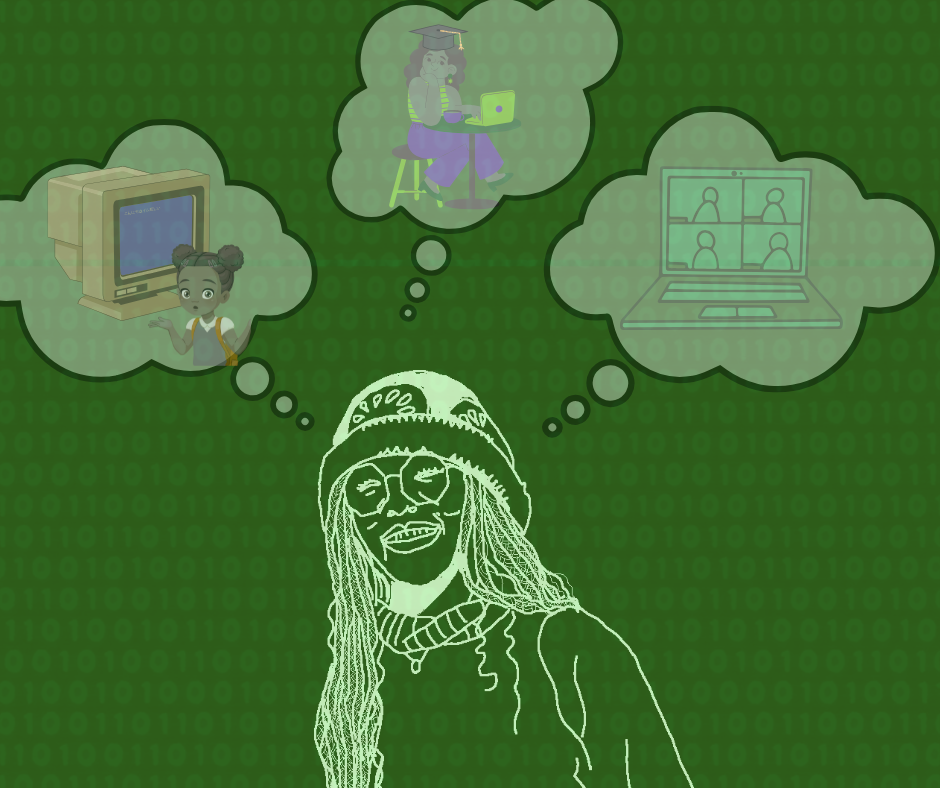
Digital empowerment inspires my work. As a Black/ native child growing up in Texas, the internet was literally a lifeline. During the long and boring after school hours, I played games and made digital art on the school computers. During hurricanes, I used my internet to access crucial alerts about flood waters and wind speeds. I sent memes to my friends in our Kik group chat from my Kindle Fire when I was grounded from my phone. On my Twitter account, I connected with progressive movements across the country. When the world shut down at the beginning of the pandemic, I used my laptop and hot spot to log into class and do my homework in between shifts at my job. Finally, I graduated from the school of Behavioral Sciences with my degrees in Political Science and Global Studies.
I got my first political job working on a congressional campaign in Pennsylvania, which I did remotely from my apartment in Houston Texas while finishing school. During the 2020 elections, door to door canvassing was not a safe option, however this is usually the entry-point for political civic engagement. Both for myself as a recently graduated political science student looking to start my political career, and for thousands of civic volunteers across the country looking to inform their neighbors. My job description was to help volunteers onto zoom and guide them through texting and calling shifts as they reminded their neighbors to vote. However it quickly became clear to me that this was something I could not do without doubling as tech support. I helped volunteers into their emails, guided them through browser tabs, and watched their smiles of satisfaction after each digital task was completed.
My supervisors, colleagues, and volunteers always said the same thing ” I do not know how you have the patience for this”. A statement I always found strange because to me, I felt absolutely privileged to be trusted enough to serve as a cyber guide. Especially because the folks I interacted with were often venturing so far outside of their comfort zones, deeper into cyber-space, because they were determined to make a positive difference in their communities. “Dammit if I have to protect the vote online, I guess this old dog better learn a new trick or two!” grumbled some of my most seasoned volunteers as they clicked down on their keys with determination, and a little too much force.
Guiding folks through cyberspace became such a routine that I have memorized the layouts of different devices, operating systems, web pages, and log in instructions. Of course, I felt like a digital genius, even though the reality was that I was struggling through learning new digital skills like database management and online security myself. I became a digital navigator not by choice, but out of sheer joy and deep humility to experience for myself as new computer users gained the confidence to use their devices to make their voices heard. Even though there were decades of life and experience between us, here we were, meeting in cyberspace, with a shared mission. To inform voters and build resilience to political manipulation and cyber scams.
Now, we are experiencing a cyber space we do not recognize, against our will at that. It is an information landscape of unfettered scams, unchecked media manipulation, and attacks on those of us who organize and exercise their right to free speech. In fact, I myself have been the target of multiple cyber attacks designed to censor and suppress my work using fear and hate.
Elon Musk doxxed my personal information to his 60 million followers. Calling the media accountability and algorithmic transparency work I do “Criminal”. I am not special in this regard, hundreds of professors, and journalists have also been targeted in this way. Without content moderation or accountability for these attacks, it is often on the victims to take steps to keep themselves safe. In my particular case, I was truly on my own, and without the support of the organization I was organizing on behalf of. They profited off of my activism, neglected my grassroots volunteer program, then laid me off for daring to speak up about these safety concerns. The president of the organization called it “misinformation” after I flagged that there were volunteers of ours in the field who were being doxxed to a hateful audience for protecting the vote. They were also on their own when it came to protecting their safety.
What came after was isolation and despair that I took many months and the support of my former union to emerge from. It was a nightmare. I was separated from the cyber activist community I cultivated right as DOGE officials raided the OPM offices, compromised our social security data, and ICE raided immigrant communities. I was thrown into unemployment as a single young Black woman in a city where Trump deployed National Guard armed to the teeth with heavy artillery. The kind words of encouragement from former colleagues and activists cemented what I knew to be true. This work is more important than ever and I was determined to continue it.
As tech billionaires consolidated their power, the thin algorithmic wall between extremist hate and public online spaces wavered. Then Charlie Kirk was assassinated on camera. The wall crumbled to dust. Neo Nazis, religious extremists, and Russian bot accounts dominated corners of the internet their ideology typically do not reach. Gore and death threats flooded our public forums. Free expression was censored and persecuted. Marginalized peoples were algorithmically sorted into For You feeds that pushed hyper-conservative ideology and racism. My own little sister was shown the Kirk assassination video and an unrelated beheading. I felt sick for days.
Now, with more conviction than ever before, I work to create an online environment with safeguards and protections against this kind of harmful content and on behalf of those facing persecution for protected free expression.
What are your thought?